- Not Search Found
History of Kedarnath Temple
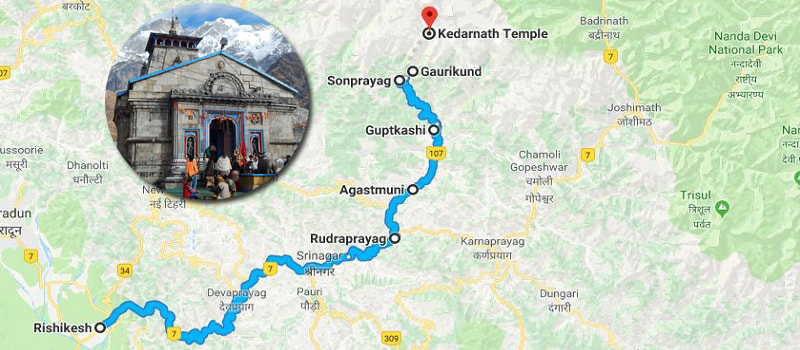
Kedarnath Temple is one of the 12 Jyotirlingas — the most sacred shrines of Lord Shiva in Hinduism — located high in the Garhwal Himalayas of Uttarakhand, at an elevation of about 11,750 feet (3,580 metres) beside the Mandakini River. It sits in the Rudraprayag district, in the heart of Devbhoomi Uttarakhand, and forms an essential part of the Chota Char Dham Yatra.
What makes Kedarnath unlike any other pilgrimage in India is the journey itself. The nearest road head is at Gaurikund, about 16 km away — and every step of that trek through the raw, untouched beauty of the Garhwal Himalayas feels like it belongs to the pilgrimage. You don't just arrive at this temple. You earn it.
Origin of Kedarnath Temple
Legend 1 — Nar and Narayan's Penance
According to the Shiva Purana, the twin sages Nara and Narayana — dual incarnations of Lord Vishnu — performed intense penance in the Himalayas. Pleased with their devotion, Shiva appeared before them and, at their request, manifested at Kedarnath permanently as a Jyotirlinga. Ever since, the lord has been believed to reside here in the triangular Shivalinga worshipped by devotees from across the world.
Legend 2 — Shiva and Parvati Choose Kedarnath
Another legend, deeply respected in local tradition, tells us that when Badrinath was taken over by Lord Vishnu in his child form, Shiva and Parvati chose to make Kedarnath their permanent abode. This belief further reinforces the idea that Kedarnath is among the most sacred sanctuaries of Lord Shiva on earth.
Legend 3 — The Pandavas and the Bull (Most Accepted)
After the Kurukshetra war, the Pandavas went searching for Shiva to seek forgiveness for the killing of their own kin. Unwilling to condone them, Shiva disguised himself and tried to disappear by burrowing into the ground at Kedarnath. Bhima, the second Pandava prince, caught hold of the disguised god's hump just as it was about to vanish beneath the earth. Shiva relented and instructed the Pandavas to worship the hump — which remained above ground at the site now known as Kedarnath.
The body parts of the bull appeared at five different locations, which together are known as the Panch Kedar temples — all dedicated to Lord Shiva. Kedarnath, where the hump appeared, is the most significant of the five.
History of Kedarnath Temple
Built by the Pandavas, Revived by Shankaracharya
Kedarnath Temple was originally built by the Pandavas, and the current temple structure was revived in the 8th century CE by Adi Shankaracharya. Some written documents say the temple was initially made from stone and wood in the 8th century, but later rebuilt using gray stones and marble by Raja Bhoj in the 11th century.
Shankaracharya came to Kedarnath from Kerala with a singular mission — to reignite the flame of Hindu devotion and re-establish pilgrimage traditions that had weakened over time. His effort turned Kedarnath into one of the most visited sacred sites in the entire subcontinent. That vision, centuries old, still holds today.
Survived 400 Years Under Ice
Here's a fact that still leaves geologists astonished. The Kedarnath Temple was engulfed totally or partially in glacial ice for almost 400 years between 1300–1900 AD, during a period known as the Little Ice Age. Scientists from the Wadia Institute of Himalayan Geology found yellow lines on the temple walls that show the effects of glaciers. The structure didn't just survive — it came out intact.
The 2013 Floods — A Miracle in Stone
On June 16–17, 2013, catastrophic flash floods devastated the entire Kedarnath valley. A large boulder got stuck behind the Kedarnath Temple, protecting it from the flood. The floodwater gushed on both sides of the temple, destroying everything in its path. Thousands lost their lives. The town was decimated.
The state suffered a huge economic blow of about 3.8 billion USD according to World Bank estimates. In March 2014, the project for restoration of Kedarnath Valley started, with its foundation laid by Prime Minister Narendra Modi, and nearly ₹700 crores were given to the state for reconstruction.
That boulder — now called Bhim Shila — is worshipped today as a symbol of divine protection.
Architecture of Kedarnath Temple
The temple is constructed from gray stone slabs, using an interlocking design without mortar, secured by iron clamps, and oriented north-south. No cement. No modern binding material. Just precision-cut stone that has outlasted glaciers, floods, and a thousand Himalayan winters.
The Architecture of Kedarnath Mandir follows the classic Nagara style of North India. It has two main sections — a Garbhagriha (sanctum sanctorum) with a tall pyramidal shikhara, and a Mandap (main hall) where pilgrims gather.
Inside, the walls feature carvings of deities, and a metal idol called the Utsav Murti — used in processions — is also placed inside. At the entrance, a large statue of Nandi, Lord Shiva's sacred bull, stands as loyal guardian, protecting the temple and welcoming devotees.
Interesting Facts About Kedarnath Temple
| Fact | Detail |
|---|---|
| Elevation | 3,583 metres (11,755 feet) above sea level |
| Location | Rudraprayag district, Uttarakhand |
| River | On the banks of Mandakini River |
| Jyotirlinga | One of 12 sacred Jyotirlingas of India |
| Little Ice Age | Buried under glacier for ~400 years (1300–1900 AD) |
| Revived by | Adi Shankaracharya, 8th century CE |
| 2026 Opening | April 22, 2026 at 8:00 AM |
| 2026 Closing | Expected November 16, 2026 (Bhai Dooj) |
- The name "Kedarnath" is derived from Sanskrit — "Kedara" meaning "field" and "Natha" meaning "lord."
- The Shiva Lingam at the temple has a unique conical shape, representing the hump of the bull that appeared at this spot. No other Jyotirlinga in the world has this shape.
- There is no head present in the main idol at Kedarnath. According to legends, the head is worshipped at the Doleshwar Mahadev Temple in Bhaktapur, Nepal.
- Behind the temple stands the Samadhi Mandir of Adi Shankaracharya, the philosopher who revived this pilgrimage — a deeply peaceful space that most pilgrims visit right after Darshan.
- The Skanda Purana is the earliest religious text to mention Kedarnath — interestingly, the Mahabharata itself does not mention the temple by name.
- The presence of Shiva at Kedarnath is believed to be svayambhu — self-manifested — meaning the deity's form is naturally occurring, not sculpted by human hands.
A Living Legacy
Kedarnath Temple is not simply a structure built of stone. It is a living legacy — shaped by mythology, tested by nature, and kept alive by millions of devotees who climb 16 km through the Himalayas every single year just to stand before that triangular Shivalinga for a few minutes.
From the Pandavas to Adi Shankaracharya, from the Little Ice Age to the 2013 floods, this temple has seen it all. And it still stands.
Kedarnath Overview
Area
Geo Location
Population
Average Climate
Elevation
State
District
Language
Best Time to Visit
Pin Code
STD Code
2.75 km²
North India
612 (2011)
-5 °C to 12 °C
3,553 meter
Uttarakhand
Rudraprayag
Hindi, Garhwali
April to November
246445
01372