Planning a Delhi to Kedarnath tour sounds simple on paper. Around 450 kilometers. A few hotel stays. One temple visit. Return home.
But in real life, this journey is very different.
It involves long mountain drives, altitude above 11,700 feet, unpredictable weather, mandatory registration, restricted vehicle movement, and a 16–17 km uphill trek. Many first-time travelers underestimate it. And that’s where problems begin.
This detailed guide breaks down everything — Delhi to Kedarnath distance, complete route map, realistic cost details, stay options, trek difficulty, safety tips, best time to visit, and common mistakes — in practical language, not brochure-style promises.
If you are planning this yatra in 2026, read this carefully.

Delhi to Kedarnath Distance – Road + Trek Explained Clearly
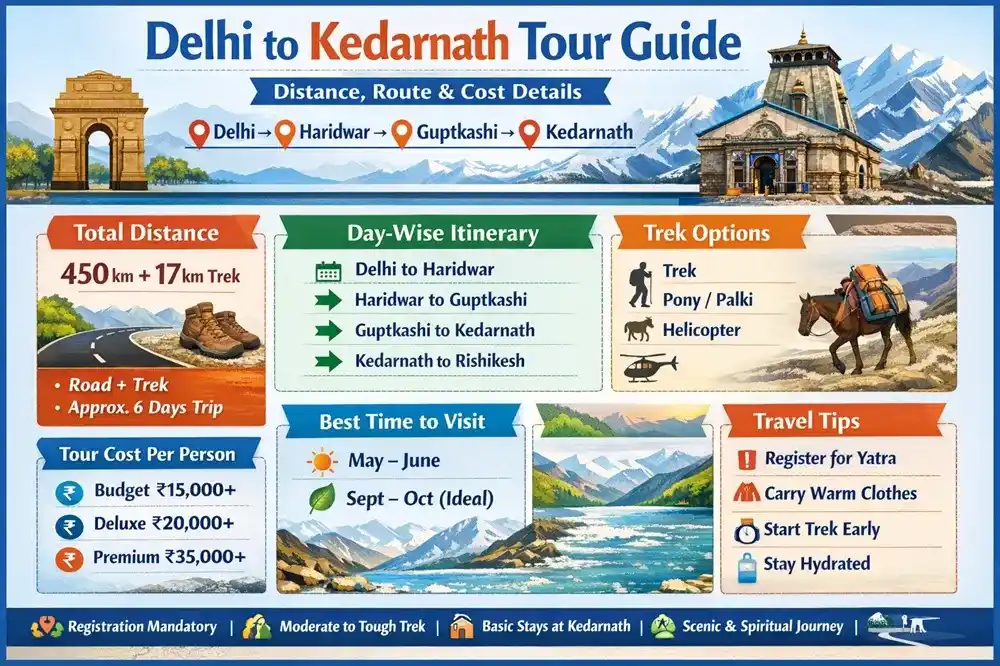
The total Delhi to Kedarnath distance is approximately 450–470 km, depending on the exact starting point in Delhi and your halt locations.
However, you cannot reach Kedarnath Temple directly by car.
The final stretch requires trekking.
Distance Breakdown Table
| Segment |
Distance |
Mode of Travel |
Approx Time |
| Delhi to Haridwar |
220 km |
Road |
6–7 hrs |
| Haridwar to Guptkashi |
210 km |
Road |
7–8 hrs |
| Guptkashi to Sonprayag |
30 km |
Road |
1–1.5 hrs |
| Sonprayag to Gaurikund |
5 km |
Local Taxi |
20 mins |
| Gaurikund to Kedarnath |
16–17 km |
Trek |
6–8 hrs |
Total road distance: ~430 km
Total trekking distance (round trip): 32–34 km
From practical experience, the trek feels longer than it looks on Google Maps.
Delhi to Kedarnath Route Map – What You Actually Experience
The most commonly used route for a Delhi to Kedarnath tour package is:
Delhi → Haridwar → Rishikesh → Devprayag → Srinagar → Rudraprayag → Guptkashi → Sonprayag → Gaurikund → Kedarnath
After Rishikesh, plains end. Mountains begin.
Roads become narrow and curved. You drive along deep river valleys. In some stretches, especially between Rudraprayag and Guptkashi, landslide-prone areas exist during monsoon.
Important Route Highlights
-
Har Ki Pauri Ganga Aarti (Haridwar)
-
Devprayag Sangam (origin of Ganga)
-
Rudraprayag (Mandakini & Alaknanda confluence)
-
Guptkashi (main Kedarnath base stay hub)
-
Sonprayag (last private vehicle parking)
What most people don’t realize is that traffic near Sonprayag can take 2–3 extra hours during peak season. Buffer time is essential.
Day-Wise Delhi to Kedarnath Tour Itinerary (5 Nights / 6 Days)
Below is a practical itinerary based on real operational flow.
Day 01: Delhi to Haridwar (220 km / 6–7 Hours)
Pickup from Delhi airport or railway station.
Drive via Meerut Expressway and NH334. Road quality is mostly smooth. However, weekend traffic near Haridwar can slow things down.
Evening visit to Har Ki Pauri for Ganga Aarti.
Stay: Hotel Suvidha Deluxe (Haridwar)
This halt helps break the long journey and avoids driver fatigue.
Day 02: Haridwar to Guptkashi (210 km / 7–8 Hours)
After breakfast, departure for Guptkashi.
Route passes through:
-
Rishikesh
-
Devprayag
-
Srinagar
-
Rudraprayag
Road condition varies. Some stretches are excellent, others under repair due to mountain cutting and Char Dham road widening.
Motion sickness tablets are advisable.
Stay: Hotel Om Anandam (Guptkashi – 2 Nights)
Guptkashi is preferred because hotels here are better compared to Sonprayag.
Day 03: Guptkashi to Kedarnath (Drive + 17 km Trek)
Early morning departure to Sonprayag.
Private vehicles are stopped here. You must take a local government taxi to Gaurikund.
From Gaurikund, the 16–17 km trek begins.
Trek Options:
-
Walking
-
Pony (₹3,500–₹4,500 approx)
-
Palki (₹5,000–₹8,000 approx)
-
Helicopter (₹6,500–₹8,500 one way approx)
Rates are regulated seasonally by local authorities.
The trek route is paved and wide. But steep in many sections.
Arrival at Kedarnath by evening. Darshan at temple.
Stay: Private Dharamshala (basic facilities due to altitude)
No luxury hotels available here. Oxygen level is lower at 3,583 meters.
Day 04: Kedarnath to Sitapur / Guptkashi
Morning darshan again if needed.
Trek back to Gaurikund. Downhill trekking is harder on knees than uphill.
Return via Sonprayag to hotel.
Rest and recovery is important.
Day 05: Sitapur to Rishikesh (205 km / 7–8 Hours)
Drive back toward Rishikesh.
Evening free for:
-
Ram Jhula
-
Laxman Jhula
-
Ganga riverside walk
Stay: Hotel Arctic Hills (Rishikesh)
Day 06: Rishikesh to Delhi (225 km / 5–6 Hours)
Return journey to Delhi.
Drop at airport or railway station.
Delhi to Kedarnath Tour Cost – Detailed Price Breakdown
Cost varies depending on category, season, and group size.
Below is a realistic estimate per person (5N/6D).
Cost Comparison Table
| Category |
Approx Price (Per Person) |
Inclusions |
| Budget |
₹15,000 – ₹18,000 |
Standard hotels + shared cab |
| Deluxe |
₹20,000 – ₹28,000 |
Private vehicle + better hotels |
| Premium |
₹35,000 – ₹50,000 |
SUV + premium category stays |
| Helicopter Add-On |
₹6,500 – ₹8,500 |
One way ticket |
Food, pony, palki, VIP darshan, personal expenses are extra.
For a family of 4, expect ₹80,000–₹1.2 lakh depending on comfort level.
Best Time for Delhi to Kedarnath Tour
Kedarnath Temple opens around late April or early May and closes around November (dates decided annually).
Seasonal Breakdown
| Month |
Condition |
| May–June |
Pleasant weather, heavy crowd |
| July–August |
Heavy rainfall, landslide risk |
| September–October |
Clear skies, best time |
| November |
Very cold, snowfall risk |
According to multiple IMD weather alerts in previous years, monsoon travel carries higher landslide probability in Uttarakhand hill districts.
September–October is often the safest and most scenic window.
Trek Difficulty – Ground Reality
The Kedarnath trek is moderate.
But altitude makes it harder.
After 10 km, breathing becomes slightly heavier. Elderly travelers should pace themselves.
Trek Preparation Tips
Medical check-up before yatra is strongly recommended.
Registration Process (Mandatory for All)
Char Dham Yatra registration is compulsory.
Options:
Biometric verification is done at multiple checkpoints.
Carry:
Without registration, entry is restricted.
Accommodation Reality at Kedarnath
Many travelers expect hotel-level comfort.
That’s unrealistic.
Due to altitude and weather, accommodation options are basic.
Facilities include:
This is normal. Adjust expectations accordingly.
Common Mistakes During Delhi to Kedarnath Tour
-
Starting trek after 9 AM
-
Not carrying woolens in May
-
Ignoring weather alerts
-
Booking helicopter last minute
-
Skipping buffer day
Mountains don’t follow city schedules.
Always keep one flexible day.
Food Availability on Route
Food options are decent in:
-
Haridwar
-
Rishikesh
-
Guptkashi
Limited but manageable options at Kedarnath.
Mostly vegetarian food only.
Avoid overeating before trek.
Safety Tips That Actually Matter
-
Check weather 24 hours before trek
-
Avoid monsoon travel if possible
-
Don’t pressure elderly to complete trek
-
Hire certified pony operators only
-
Keep emergency contact numbers saved
Local administration is active, but personal responsibility is crucial.
Who Should Consider Helicopter Option?
Helicopter services operate from Phata, Sersi, and Guptkashi.
Weather dependent. Delays common.
Frequently Asked Questions
1. What is the total distance from Delhi to Kedarnath?
The total Delhi to Kedarnath distance is approximately 450–470 km. Out of this, around 430 km is by road up to Gaurikund, followed by a 16–17 km trek to reach the temple.
2. How many days are required for a Delhi to Kedarnath tour?
A minimum of 5 to 6 days is required for a comfortable Delhi to Kedarnath tour. This includes travel, trek time, darshan, and return journey without rushing.
3. What is the cost of a Delhi to Kedarnath tour package?
The cost usually ranges between ₹15,000 to ₹28,000 per person for a 5N/6D trip, depending on hotel category and transport type. Helicopter services cost extra.
4. Is the Kedarnath trek difficult?
The 16–17 km trek is considered moderate in difficulty. It is manageable for healthy adults but can be tiring due to altitude and steep stretches.
5. Can senior citizens visit Kedarnath?
Yes, but senior citizens should consult a doctor before planning the trip. Many choose the helicopter option from Phata or Sersi to avoid the long trek.
6. Is registration mandatory for Kedarnath Yatra?
Yes, registration for Char Dham Yatra is compulsory. Pilgrims must complete biometric registration either online or at authorized counters before proceeding.
7. What is the best time to plan Delhi to Kedarnath tour?
The best time is May–June and September–October. Monsoon months (July–August) are not recommended due to landslide risks.
8. Are private vehicles allowed till Kedarnath temple?
No. Private vehicles are allowed only up to Sonprayag. From there, pilgrims must take a local taxi to Gaurikund and then begin the trek.
9. Is helicopter service available for Kedarnath?
Yes, helicopter services operate from Phata, Sersi, and Guptkashi. Advance booking is highly recommended during peak season.
10. What kind of accommodation is available at Kedarnath?
Accommodation at Kedarnath is basic due to high altitude. Most stays are dharamshalas or simple lodges with limited facilities.
11. Is food easily available during the trek?
Yes, small shops and food stalls are available along the trek route. However, options are simple vegetarian meals and snacks only.
12. Is Kedarnath safe for children?
Children above 7–8 years can complete the trek with supervision. Parents should ensure proper warm clothing and regular hydration during the climb.
Final Thoughts
A Delhi to Kedarnath tour is not luxury tourism.
It’s a mountain pilgrimage.
It tests stamina, patience, and planning.
But when you stand in front of Kedarnath Temple with snow-covered peaks behind it, everything feels worth it.
Plan smart. Travel prepared. Respect the mountains.
If done right, this journey becomes unforgettable — not stressful.